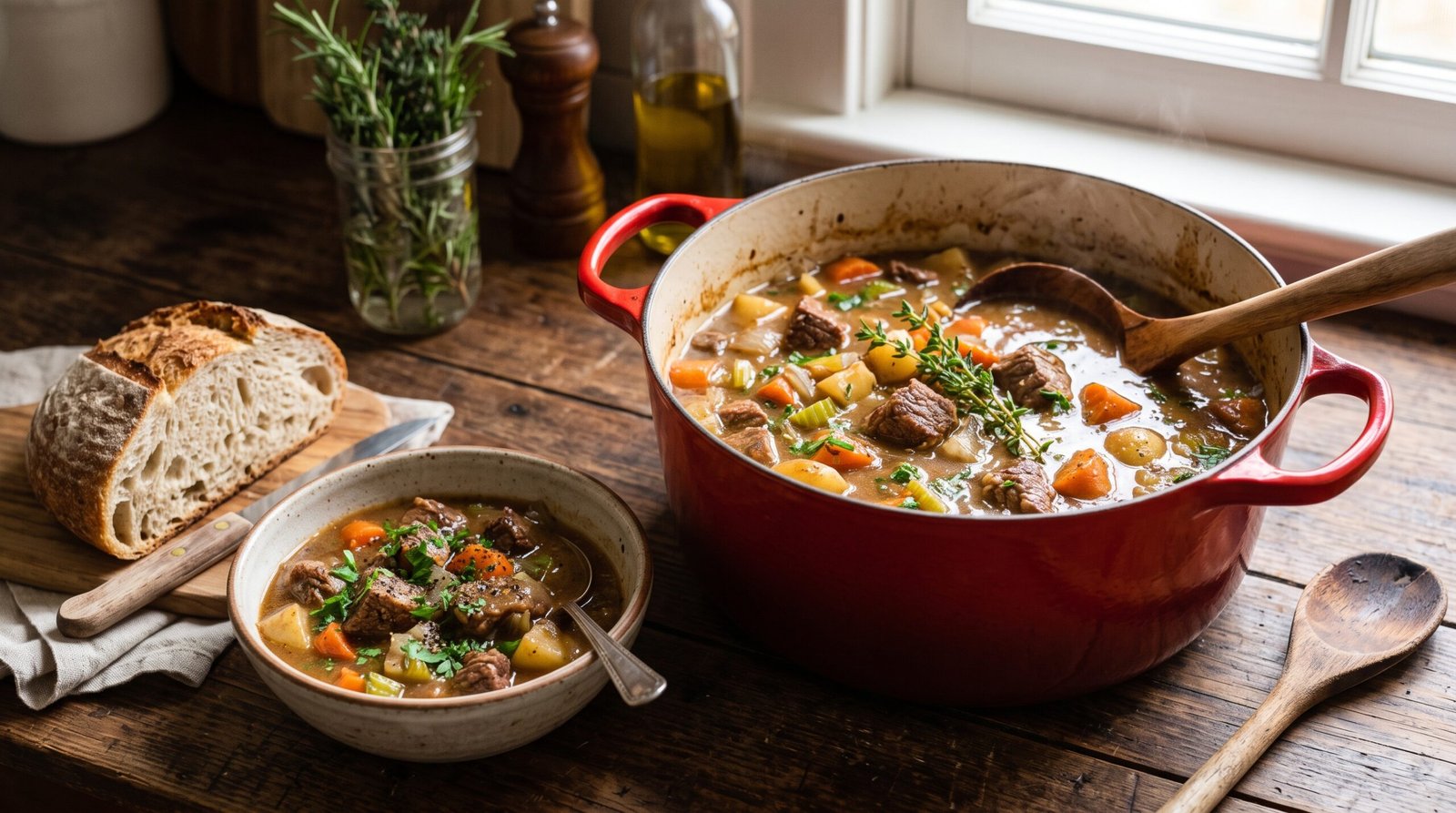
There’s a reason this dish never goes out of style. A thick, rich beef stew simmered low and slow in a Dutch oven hits differently than anything else on a cold evening deep, layered flavour, meat so tender it falls apart, vegetables soaked through with that gorgeous gravy. And once you know the right method, it’s surprisingly hard to mess up.
If you’ve been making beef stew any other way, this will change things for you.
Why the Dutch Oven Is the Secret Weapon
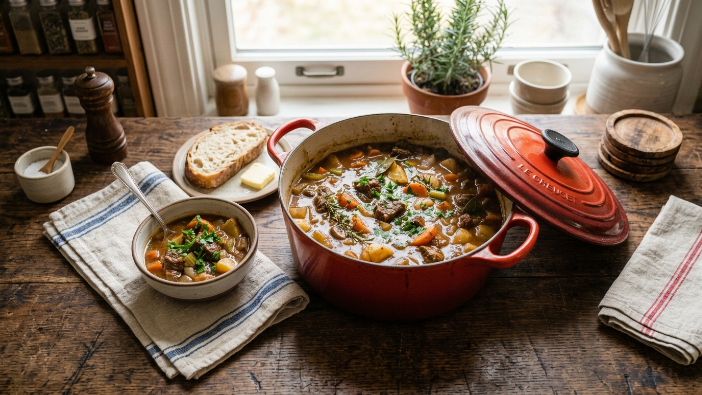
Not all pots are built equal. A Dutch oven ideally enamelled cast iron holds steady, even heat in a way most standard pots simply can’t match. That matters a lot for slow cooking. <a href=”#sources”>[See research notes below]</a>
The thick walls mean no hot spots scorching the bottom of your stew, and the heavy lid traps steam and recirculates it back into the pot. What you get is a self-basting environment where the beef braises beautifully, breaking down all that tough connective tissue into something rich and silky.
You can go stovetop or oven both work brilliantly in a Dutch oven. Most serious home cooks prefer the oven method for the last stage: once you’ve built your base on the hob, you slide the whole pot in at around 300–325°F (150–165°C) and let physics do the rest.
READ MORE: The Best Red Potato Salad Recipe You’ll Make All Summer
The Cut of Beef That Makes All the Difference
Don’t waste money on an expensive cut here. This is one of those happy cases where cheaper is actually better.
Chuck roast is what you want. It comes from the shoulder, it’s well-marbled, and it’s packed with connective tissue — which sounds like a problem but is actually the point. During a long, slow braise, that connective tissue breaks down into gelatin, giving your gravy a velvety, glossy body that no thickening agent can quite replicate.
Avoid pre-packaged “stew meat” from the supermarket if you can. It tends to be leaner, from multiple cuts, and it often ends up dry and stringy. Buy a whole chuck roast and cut it yourself into 1 to 1½ inch cubes. Fifteen minutes of prep work, and the payoff is enormous.
If chuck isn’t available, bottom round can work, but expect a slightly less luxurious result.
The Full Recipe: Dutch Oven Beef Stew
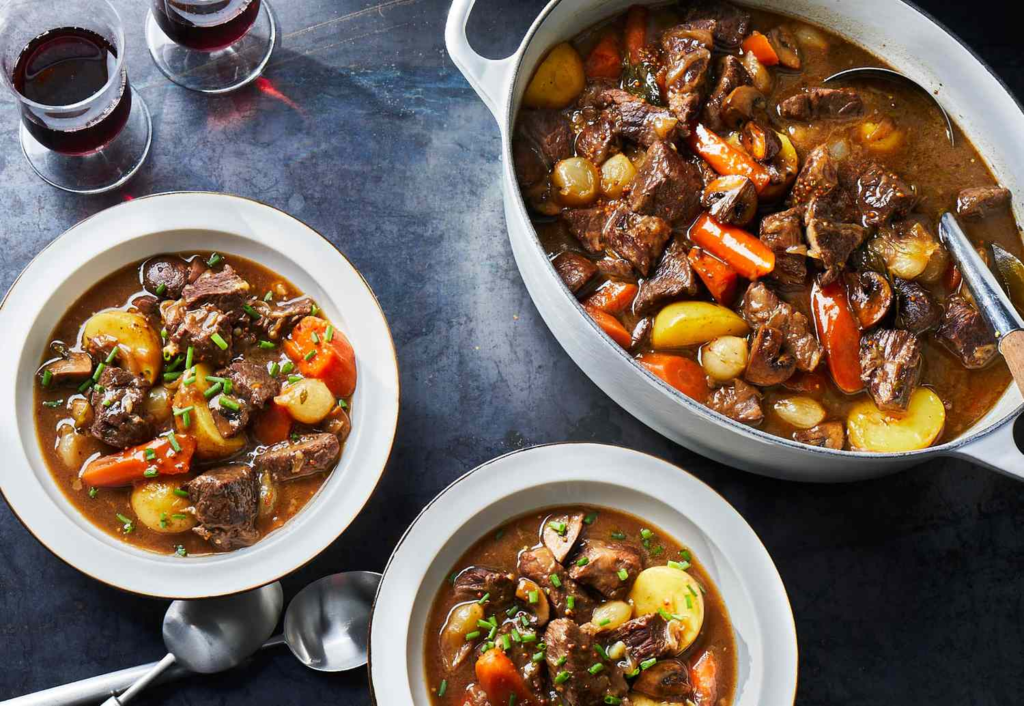
Ingredients (Serves 4–6)
| Item | Quantity |
|---|---|
| Chuck roast, cut into 1½ inch cubes | 1 kg / 2.2 lbs |
| All-purpose flour | 3 tbsp |
| Salt and black pepper | To taste |
| Olive oil or avocado oil | 3 tbsp |
| Brown onion, diced | 1 large |
| Garlic cloves, minced | 4 |
| Tomato paste | 2 tbsp |
| Worcestershire sauce | 1 tbsp |
| Dry red wine (or extra beef broth) | 125ml / ½ cup |
| Beef broth (low-sodium) | 750ml / 3 cups |
| Carrots, chopped | 3 medium |
| Celery stalks, chopped | 2 |
| Baby potatoes (or Maris Piper, cubed) | 500g |
| Fresh thyme | 4 sprigs |
| Bay leaves | 2 |
| Frozen peas | 100g (optional, added at end) |
| Fresh parsley, chopped | To garnish |
Method
Step 1: Season and Sear the Beef
Preheat your oven to 160°C (325°F). Pat the beef cubes dry with kitchen paper — this is not optional. Wet meat doesn’t sear, it steams. Toss the cubes in flour, salt, and pepper until lightly coated.
Heat two tablespoons of oil in your Dutch oven over medium-high heat until shimmering. Add the beef in batches — don’t crowd the pan. Leave each piece undisturbed for about 4–5 minutes until a proper crust forms, then turn. You’re looking for deep golden-brown on the outside. That crust is flavour. Once done, set the beef aside on a plate.
This process is called the Maillard reaction — the chemical browning that creates hundreds of flavour compounds. It’s the single most important step in the recipe.
Step 2: Build the Flavour Base
Reduce the heat to medium. Add a splash more oil if needed, then cook the diced onion for 5–7 minutes until softened and translucent. Add the garlic and cook for a further minute.
Stir in the tomato paste and cook it out for 2 minutes — this concentrates the flavour and removes any tinny taste. Add the Worcestershire sauce, then pour in the red wine.
Now scrape up every last bit of browned residue from the bottom of the pot. Those bits — called fond — are pure concentrated flavour. Don’t leave any behind.
Step 3: Add the Liquid and Braise
Return the beef to the pot along with any resting juices from the plate. Pour in the beef broth until the meat is just barely covered. Add thyme sprigs and bay leaves. Bring to a gentle simmer on the hob.
Place the lid on and transfer the Dutch oven to the oven. Cook at 160°C for 1 hour and 30 minutes.
Step 4: Add the Vegetables
After the first braise, pull the pot out and add the carrots, celery, and potatoes. Stir everything gently and return to the oven, lid on, for another 45–60 minutes until the vegetables are soft and the beef is completely tender and pulls apart easily.
Step 5: Finish and Season
Remove the bay leaves and thyme sprigs. Taste the stew and adjust the seasoning — it likely needs a little more salt at this point. If using, stir in the frozen peas and let them warm through for 3–4 minutes with the pot back on the hob on low heat.
Scatter over fresh parsley and serve with thick crusty bread or buttery mash.
The Mistakes Most People Make (And How to Avoid Them)
Not drying the beef before searing
Moisture is the enemy of a good sear. Even a minute with kitchen paper makes a real difference.
Adding all the vegetables at the start
Root vegetables need time, but not as much as the beef. Add them halfway through or they’ll turn to mush.
Cooking at too high a temperature
Low and slow is not just a suggestion — it’s the mechanism. Boiling the stew rather than gently braising it will make the beef tough and the gravy thin.
Using water instead of broth
The quality of your liquid becomes the quality of your gravy. Use proper beef broth, and if you want to skip the wine, replace it with a splash of balsamic vinegar for the same depth of flavour.
READ MORE: Korean Porridge Near Me Find Juk & Love Every Bite
Stovetop vs Oven: Which Is Better?
Both methods work. Here’s a quick comparison:
| Method | Time | Result |
|---|---|---|
| Oven braise | 2.5–3 hours total | Most even heat, hands-off, deeply flavoured |
| Stovetop simmer | 2–2.5 hours | Slightly more attention needed, great results |
The oven method is generally preferred by most cooks because the heat surrounds the pot from all sides rather than just from below. If you’re going stovetop, keep the heat very low and check in every 30 minutes or so.
Make-Ahead and Storage Tips
This is genuinely one of those dishes that gets better overnight. The flavours meld and deepen as it rests in the fridge. If you can, make it the day before and reheat it gently on the hob with a splash of broth to loosen the gravy.
Fridge: Keeps well for 3–4 days in an airtight container.
Freezer: Freezes beautifully for up to 3 months. Note that potatoes can go slightly grainy after freezing — if this bothers you, freeze the stew without them and add freshly cooked potatoes when you reheat.
Reheating: Always low and slow. Add a little broth if the stew has thickened up in the fridge.
Variations Worth Trying
- Red wine version: Double the wine and halve the broth for a richer, more Bourguignon-style stew.
- Gluten-free: Swap plain flour for a gluten-free 1:1 blend or use arrowroot starch — works just as well.
- Extra hearty: Add bone-in short ribs alongside the chuck roast for extra depth.
- Herb upgrade: Fresh rosemary alongside the thyme transforms the flavour profile entirely.
Conclusion
A proper beef stew recipe Dutch oven style isn’t complicated — it just requires good technique and a little patience. Dry your beef, sear it hard, deglaze thoroughly, braise low and slow, add vegetables late. Follow those five principles and you’ll produce something that tastes like it took a professional chef to make.
READ MORE: Where to Find Great Porridge Near Me And Why Everyone’s Obsessed
The Dutch oven does the heavy lifting. You just have to get out of its way.
FAQs
What is the best cut of beef for Dutch oven stew?
Chuck roast is the top choice. It’s marbled with fat and connective tissue that breaks down into tender, juicy meat and a rich, glossy gravy during a long, slow braise.
Can I make beef stew in a Dutch oven without wine?
Replace the wine with extra beef broth plus a tablespoon of balsamic vinegar. This gives you similar acidity and depth without the alcohol.
How long does beef stew take in a Dutch oven?
Most recipes call for 2.5 to 3 hours total — roughly 1.5 hours for the initial beef braise, then another 45–60 minutes after adding vegetables. The exact time depends on your oven and the size of your beef cubes.
Can I overcook beef stew in a Dutch oven?
Technically yes, but the window is generous. Check for tenderness after the second braise stage. Once the meat pulls apart easily with a fork, it’s done. Cooking much beyond that point can make it dry and stringy.
Do I have to sear the beef first?
You don’t have to, but you really should. Searing creates the Maillard reaction — a browning process that produces hundreds of complex flavour compounds. Skipping it produces a noticeably flatter stew.
What size Dutch oven do I need for beef stew?
A 5.5 to 7 quart Dutch oven comfortably handles a 4–6 serving stew. If you’re scaling up, go larger — the pot should never be more than two-thirds full.
For more updates visit: STORY VISTA