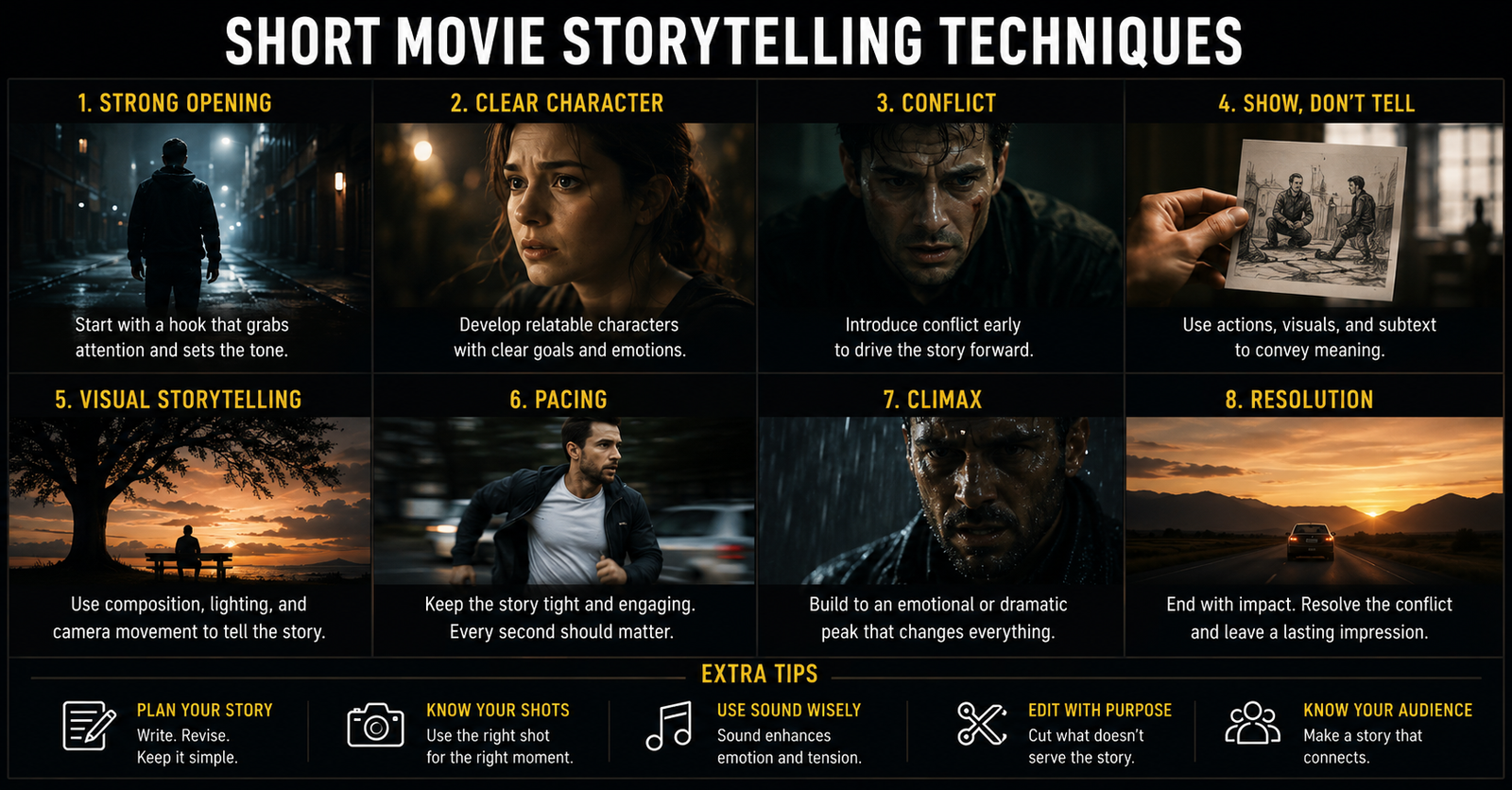
Ever watched a five-minute short film and felt more wrecked by it than a two-hour blockbuster? That’s not an accident. Short films don’t have the luxury of slow build-ups, extra subplots, or a “we’ll explain it later” scene. Every second has to earn its place, or the whole thing collapses.
If you’ve got a short film idea sitting in your notes app or you’re just curious why some shorts hit so hard while others feel like a rushed trailer this guide breaks down the actual storytelling techniques that separate forgettable shorts from the ones that win festivals, go viral, or launch careers.
Why Short Films Are Actually Harder to Write Than Features
Here’s the myth: short films are “easy” because they’re short. Here’s the truth: shorter formats leave zero room to hide weak writing.
In a feature film, you can spend ten minutes on a slow character introduction and still have two hours left to fix things. In a short film, you might have three minutes, total. That means:
- There’s no space for a scene that doesn’t move the story forward
- Backstory has to be implied, not explained
- Your character needs to feel real almost instantly
- The ending has to land the moment it happens — no fade-out to soften it
This is why writing instructors often compare short film scripts to short stories rather than mini-features. In a novel, the scene is the basic unit. In a short story — and a short film — the sentence, or the shot, is the basic unit. Every single one has to pull weight.
Also Read: 10 Storytelling Techniques That Actually Hook Readers
1. Start In the Middle of Something
The single biggest technique that separates strong shorts from weak ones is where the story actually begins.
Weak shorts open with setup: a character waking up, getting ready, walking somewhere while narration explains their life. Strong shorts open in medias res — literally “in the middle of things.” A character already mid-argument. Someone already running. A conversation that’s clearly been building before the camera even started rolling.
You don’t need an opening title sequence. You don’t need three minutes of “context.” Give the audience motion, tension, or mystery in the first ten seconds, and let backstory leak in later through behavior, not exposition.
2. Pick One Emotion and Build Everything Around It

Feature films can juggle multiple emotional threads — love, betrayal, ambition, grief — all in the same story. Short films rarely have room for more than one dominant feeling.
Decide early: is this a film about loss? About longing? About quiet hope? Once you know the emotional core, every choice you make should serve it:
- Framing — tight close-ups build intimacy; wide, isolating shots build loneliness
- Color — warm tones read as comfort; cold, desaturated tones read as distance or tension
- Sound — a well-placed silence can hit harder than a swelling score
- Pacing — slow down for emotional beats, speed up for urgency
When every technical choice reinforces the same emotional thread, even a three-minute short can feel devastatingly complete.
3. Show, Don’t Tell — Especially When You Have No Time to Tell
“Show, don’t tell” gets repeated so often it’s practically a cliché, but in short filmmaking it’s not optional — it’s survival. You simply don’t have the minutes for a character to sit down and explain how they feel.
Instead, let behavior and visuals do the talking:
- A wilting plant on a windowsill can say “this relationship is dying” faster than a line of dialogue
- Two characters shown in separate frames, then gradually sharing the same frame, can visually chart a relationship without a single word about it
- A character filmed through a doorway or narrow hallway can silently communicate entrapment or isolation
Visual metaphors are one of the most efficient storytelling tools in short film precisely because they compress meaning into a single image instead of a paragraph of dialogue.
4. Keep the Conflict Simple — But Make It Real
You don’t need a complicated plot. You need one clear conflict that the audience understands almost instantly, internal or external.
A good short film conflict can be as simple as two characters wanting the same object, one character hiding a secret from another, or someone facing a decision with no good option. What makes it work isn’t complexity — it’s clarity and stakes. The audience should know, within the first minute, what this character wants and what’s standing in their way.
5. Structure Still Matters — Just Compressed
Even a five-minute short benefits from structure. The classic three-act shape — setup, complication, resolution — still applies, just squeezed dramatically:
| Act | Feature Film | Short Film |
|---|---|---|
| Setup | 20–30 minutes | A few seconds to a minute |
| Complication | 60–90 minutes | The bulk of the runtime |
| Resolution | 20–30 minutes | Often a single final shot or line |
Some filmmakers lean on a mini version of the Hero’s Journey — a character faces an unexpected disruption, struggles with it, and comes out changed by the end, even if “changed” just means one small realization. The scale is tiny, but the shape is familiar enough that audiences instinctively follow it.
6. Every Scene Has to Justify Its Existence
In a feature, you can afford a scene that exists mostly for atmosphere or a side character’s arc. In a short, ask yourself before every single scene: what does this reveal about character, or how does this move the story forward? If the honest answer is “it doesn’t, really,” cut it. Ruthless editing isn’t a nice-to-have in short filmmaking — it’s the craft itself.
The exception is deliberately atmospheric or poetic shorts, where mood is the story. But that’s a conscious artistic choice, not an accident from not knowing what to cut.
7. Let the Ending Do the Emotional Work
Because there’s no time for a long resolution, the final image or line in a short film often has to carry a disproportionate amount of meaning. Many of the most memorable shorts end on a single visual beat — a look, a small gesture, an object — rather than a tidy, explained conclusion. Audiences remember the last thing they see, so it’s worth treating your closing shot with as much care as your opening one.
A Quick Note on Sound
It’s easy to obsess over visuals and treat sound as an afterthought, but poor audio is one of the fastest ways to make a short film feel amateur. If viewers are straining to understand dialogue, they disengage emotionally — no matter how strong the story is. Planning your locations and shots with sound quality in mind from the start (rather than hoping to “fix it in post”) pays off far more than most first-time filmmakers expect.
Final Thoughts
Short film storytelling isn’t feature filmmaking with the fat trimmed off — it’s its own discipline, closer in spirit to a short story than a novel. The techniques that make it work — starting in the middle of the action, committing to one emotion, showing instead of telling, and editing without mercy — all come from the same underlying principle: every choice has to earn its place, because there simply isn’t time for anything that doesn’t.
Also Read: Suckernpunch: Meaning, Story, Themes, and Cultural Impact
If you’re sitting on a short film idea, the best next step isn’t a bigger budget or fancier gear. It’s a script that respects how little time it has — and uses every second of it on purpose.
FAQs
1. How long should a short film be?
Most short films run anywhere from 1 to 40 minutes, though many festivals define “short” as under 30 or 40 minutes. There’s no strict rule — the story should be exactly as long as it needs to be, and no longer.
2. What’s the biggest mistake new short filmmakers make?
Trying to cram a feature-length plot into a few minutes. Short films work best with one clear conflict and one emotional thread, not a sprawling story compressed too tightly.
3. Do short films need a three-act structure?
Not strictly, but most successful shorts still follow a compressed version of setup, complication, and resolution, even if each act only lasts seconds.
4. How important is dialogue in short filmmaking?
Less than you’d think. Because time is limited, visuals, expressions, and sound often carry more narrative weight than dialogue. The strongest shorts tend to say more with images than with words.
5. Can a short film work without a traditional plot?
Yes some of the most acclaimed shorts are mood- or theme-driven rather than plot-driven. This works best when the atmosphere itself is intentional, not a substitute for a story that isn’t fully worked out.
6. What’s the fastest way to improve short film storytelling skills?
Watch a lot of short films critically, not just for entertainment. Pay attention to where they start, how much they explain versus imply, and how they end — then study how those choices shape the emotional impact.
For more updates visit: STORY VISTA






2 Comments