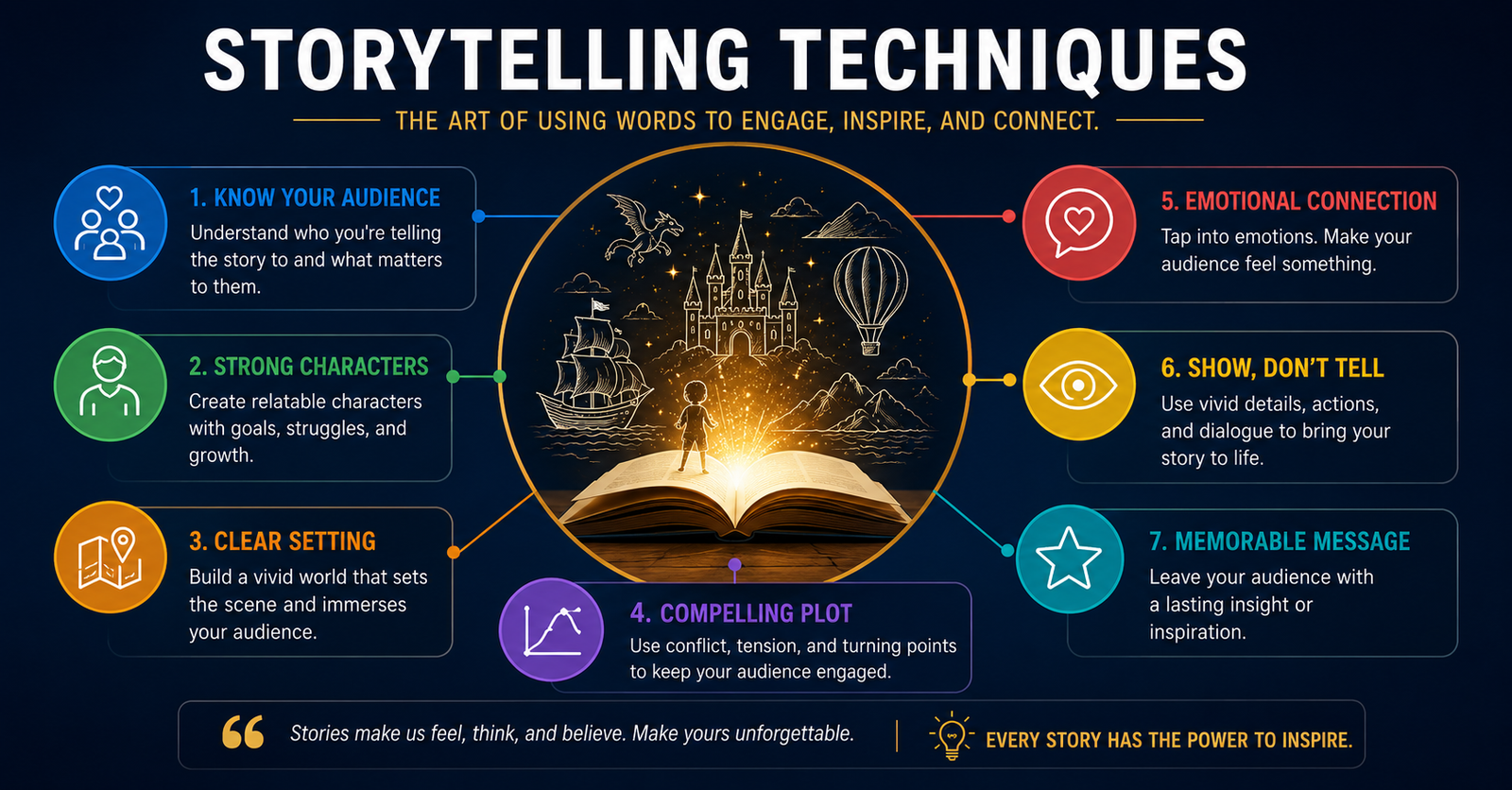
You’ve scrolled past a thousand posts today. Most of them said something. Almost none of them made you feel anything. That’s the gap storytelling techniques are built to close and it’s why the brands, creators, and writers who bother to learn them keep winning attention that everyone else is fighting over.
Here’s the thing nobody tells you upfront: storytelling isn’t a personality trait. It’s not something you’re either born with or not. It’s a set of specific, learnable moves the same ones novelists, screenwriters, and top content creators reach for again and again. Once you know what they are, you start seeing them everywhere: in a friend’s group chat rant, in a five-second TikTok hook, in the opening line of a New Yorker profile.
This guide breaks down the storytelling techniques that consistently work, why they work, and how to actually use them whether you’re writing a blog post, a brand caption, a client pitch, or just trying to tell a better story at dinner.
What Are Storytelling Techniques, Exactly?
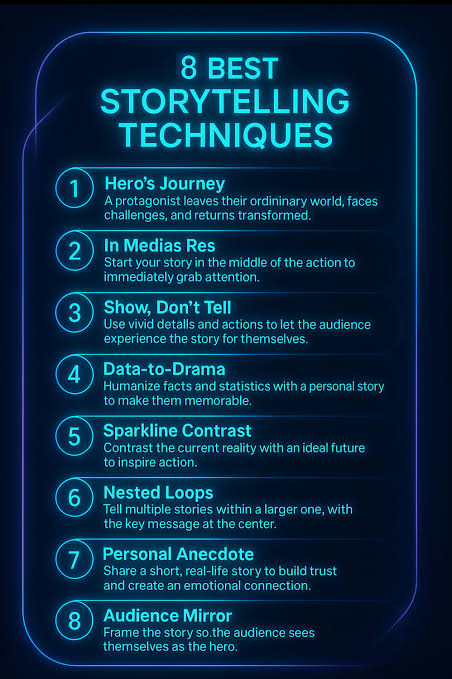
Storytelling techniques are the structural and stylistic tools writers use to turn plain information into something people want to follow. A list of facts informs. A story makes someone lean in. The difference usually comes down to a handful of ingredients: a clear point of view, tension, sensory detail, and a shape — a beginning that hooks, a middle that complicates, and an end that pays off.
You don’t need all of them in every piece of writing. But the strongest content usually borrows at least two or three.
Why Storytelling Works (and Why It’s Not Just a Buzzword)
There’s a reason “just be more authentic” and “add a story” have become nearly universal content advice. Human brains are wired to process narrative differently than they process raw data — we remember characters, conflict, and outcomes far more easily than we remember statistics or bullet points. That’s not a marketing theory; it’s basic cognitive science, and it’s the whole reason oral traditions survived for thousands of years before anyone wrote anything down.
Also Read: Servantful Meaning, Mindset, Leadership Model, and Modern Business Impact
In a feed flooded with AI-generated, algorithm-chasing content, a genuinely well-told story stands out even more than it used to. Readers can tell, often within a sentence or two, whether something was actually lived and felt or just assembled to hit a word count.
The Core Storytelling Techniques Worth Learning
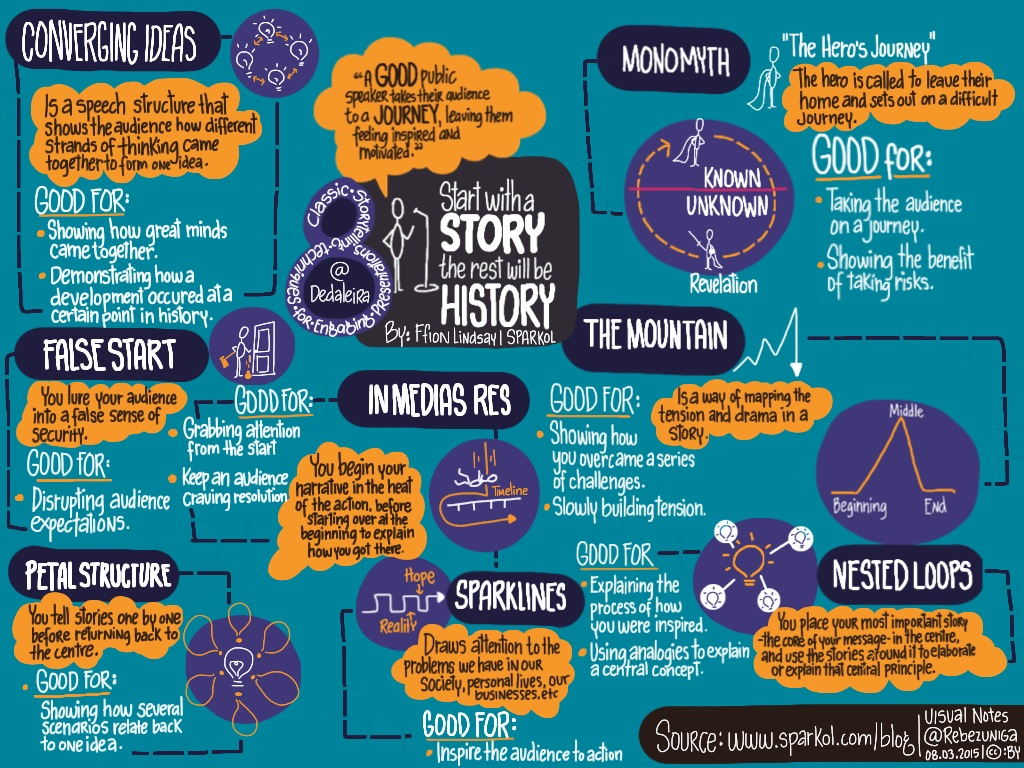
1. Start in the Middle of the Action (In Medias Res)
Don’t open with throat-clearing. Skip the “let me tell you about the time” setup and drop the reader straight into a moment: the phone ringing at 2 a.m., the email that changed everything, the second before the mistake. Backfill context after you’ve earned their attention, not before.
2. Give the Story a Clear Point of View
Every strong story is told from somewhere — a specific person’s eyes, a specific stake in the outcome. Vague, everyone-and-no-one narration is the fastest way to lose a reader. If you’re writing a brand story, put an actual human at the center of it, not “our company.”
3. Build in Real Conflict
No tension, no story — just an update. Conflict doesn’t have to mean drama or disaster. It can be as small as uncertainty, a deadline, a decision with no obvious right answer. The job of conflict is simple: make the reader need to know what happens next.
4. Use the Three-Act Shape
It’s ancient for a reason. Setup (introduce the situation and the stakes), confrontation (things get harder, attempts fail, tension builds), resolution (the payoff, the change, the lesson). You can compress this into three sentences or stretch it into three thousand words — the shape holds either way.
5. Show, Don’t Just Tell
“She was nervous” is information. “She reread the email four times before hitting send” is a story. Concrete, sensory, specific detail does more emotional work than any adjective ever will.
6. Make the Reader the Hero, Not the Brand
This is the single biggest shift between content that sells and content that just talks about itself. If you’re writing for a business, your product is the guide or the tool — the reader (or customer) is the one on the journey. Nobody wants to watch a brand admire itself.
7. Use the Callback
Plant a small detail early — a phrase, an object, a joke — and bring it back later with new meaning. Callbacks make writing feel intentional and give readers a small, satisfying “click” of recognition.
8. Write Toward a Turn, Not a Summary
Endings that just restate what already happened fall flat. The strongest endings deliver a small shift — a changed mind, a twist, a moment of clarity — even if it’s subtle.
9. Use Dialogue and Voice
A single well-placed line of real speech can do more than a paragraph of description. It adds texture, personality, and proof that the story is grounded in something real.
10. Know When to Go Short
Not every story needs a beginning, middle, and end spread across 1,000 words. Micro-storytelling — a two-line caption, a single sharp image with one sentence of context — works because it trusts the reader to fill in the rest.
Storytelling Techniques at a Glance
| Technique | What It Does | Best For |
|---|---|---|
| In medias res | Hooks attention instantly | Openings, video scripts, hooks |
| Clear point of view | Builds trust and relatability | Personal essays, brand stories |
| Real conflict | Creates forward momentum | Any long-form content |
| Three-act structure | Gives the piece a satisfying shape | Blog posts, case studies |
| Show, don’t tell | Makes writing feel real | Descriptions, scenes |
| Reader-as-hero | Centers the audience, not the brand | Marketing, sales content |
| Callbacks | Rewards attentive readers | Longer pieces, series content |
| Earned endings | Leaves a lasting impression | Conclusions, closing lines |
| Dialogue and voice | Adds authenticity and texture | Profiles, interviews |
| Micro-storytelling | Works within short attention spans | Social captions, ads |
Common Mistakes That Kill a Good Story
- Starting too early. If your first three sentences are backstory, you’ve already lost half your readers.
- No stakes. If nothing is at risk — even something small — there’s no reason to keep reading.
- Over-polishing. A story that sounds too perfect starts to feel manufactured. A little roughness reads as honest.
- Forgetting the point. A story needs to be about something. Entertaining detail without a takeaway just meanders.
- Making it about you when it should be about them. Especially true in marketing and brand writing — readers care about their own transformation, not yours.
How to Practice Storytelling Techniques (Even If You’re Not a “Writer”)
You don’t need a screenwriting degree. Start small:
- Rewrite one boring sentence from your last piece of content using a concrete, sensory detail instead of an adjective.
- Take a recent update, announcement, or “we did this” post and rewrite it from the customer’s point of view instead of the brand’s.
- Practice cutting your openings — delete the first two sentences of your next draft and see if it still works. It almost always does.
- Keep a running note of small real moments from your day or your work. These become the raw material for stories later.
Like any skill, storytelling improves through repetition, not theory. Read the paragraph you wrote out loud. If it sounds like a memo, rewrite it like you’re telling a friend.
Final Thoughts
Storytelling techniques aren’t tricks to manipulate an audience — they’re tools to make sure the truth of what you’re saying actually lands. In a world producing more content than any human could ever read, the writers, creators, and brands who take the time to shape their message into something worth following are the ones people remember, trust, and come back to.
Also Read: 404.594.9134 and the Meaning of Modern Connection
You don’t need every technique in every piece. Pick one or two, apply them deliberately, and notice what changes.
FAQs
What are the most important storytelling techniques for beginners?
Start with just two: a clear point of view and real conflict. Nail those first, and structure and style will follow more naturally with practice.
Are storytelling techniques only useful for fiction writers?
They’re used just as heavily in marketing, journalism, public speaking, social media, and even everyday conversation. Any time you’re trying to hold someone’s attention, storytelling techniques apply.
How long should a story be to be effective?
There’s no fixed length. A two-sentence Instagram caption can use storytelling techniques just as effectively as a 2,000-word feature. What matters is whether it has a clear shape, not a word count.
Can AI-generated content use storytelling techniques well?
AI tools can apply structural techniques like the three-act shape reasonably well, but the specific, lived-in detail that makes a story feel real usually still needs a human hand — that’s increasingly what sets genuinely engaging content apart.
What’s the difference between storytelling and just sharing information?
Information tells someone a fact. A story gives that fact a shape, a stake, and a reason to care. The same facts can be delivered either way — storytelling is the choice to wrap them in narrative.
Do storytelling techniques work for business and B2B content, not just lifestyle brands?
arguably more so. B2B buyers are still people making decisions under uncertainty — case studies, client transformation stories, and founder narratives all rely on the same core techniques as any other story.





2 Comments