Whether you are measuring out liquid vitamins, double-checking a pet’s prescription, or tackling a pharmacology nursing quiz, trying to convert 1 mg to ml can make your head spin.
At first glance, it feels like it should be simple arithmetic. But then you realize: milligrams (mg) measure weight, while milliliters (ml) measure liquid volume.
So, how many milliliters are actually in 1 milligram?
The quick answer: There is no single universal conversion rate for all liquids.
- For pure water, 1 mg equals 0.001 ml (or $1\text{ ml} = 1,000\text{ mg}$).
- For medications or supplements, 1 mg equals anywhere from 0.02 ml to 1 ml or more, depending on the liquid’s concentration ($mg/ml$) printed on the label.
Let’s break down the quick formula, look at simple real-world examples, and learn how to convert milligrams to milliliters without driving yourself crazy.
The Golden Formula: How to Convert mg to ml
To convert milligrams to milliliters, you must know the concentration or density of the liquid.
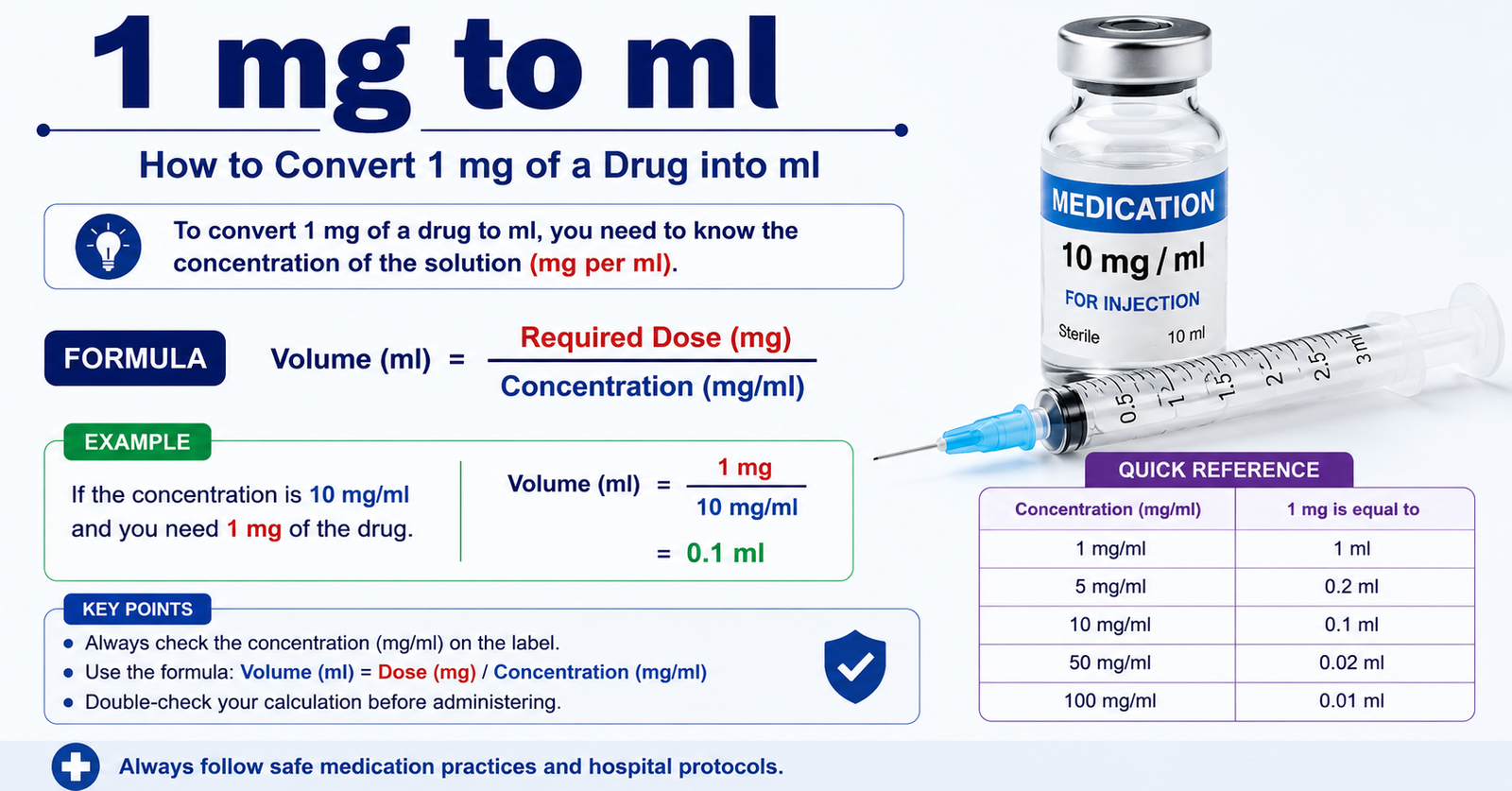
The General Formula for Liquid Medications
For prescriptions, syrups, and drops, the concentration tells you how many milligrams of active ingredient live inside each milliliter of liquid.
$$\text{Volume (ml)} = \frac{\text{Dose in Milligrams (mg)}}{\text{Concentration (mg/ml)}}$$
             Desired Dose in Milligrams (mg)
Volume (ml) = ─────────────────────────────────
               Medication Concentration (mg/ml)
⚠️ Safety First: When calculating doses for human or veterinary medications, always verify your numbers with a doctor, pharmacist, or certified healthcare professional. Never guess your medicine’s concentration!
1 mg to ml Conversion Table for Common Liquid Concentrations
If you hold a liquid medicine bottle, look closely at the front label. You will usually see a strength ratio listed like 1 mg/ml, 5 mg/ml, or 25 mg/5 ml.
Here is how 1 mg converts across typical liquid strengths:
| Liquid / Medication Concentration | Formula Calculation | Resulting Volume (ml) |
| Pure Water ($1,000\text{ mg/ml}$) | $1\text{ mg} \div 1,000$ | $0.001\text{ ml}$ |
| $1\text{ mg/ml}$ Strength | $1\text{ mg} \div 1$ | $1.0\text{ ml}$ |
| $2\text{ mg/ml}$ Strength | $1\text{ mg} \div 2$ | $0.5\text{ ml}$ |
| $5\text{ mg/ml}$ Strength | $1\text{ mg} \div 5$ | $0.2\text{ ml}$ |
| $10\text{ mg/ml}$ Strength | $1\text{ mg} \div 10$ | $0.1\text{ ml}$ |
| $20\text{ mg/ml}$ Strength | $1\text{ mg} \div 20$ | $0.05\text{ ml}$ |
| $50\text{ mg/ml}$ Strength | $1\text{ mg} \div 50$ | $0.02\text{ ml}$ |
Why Can’t You Do a Direct Swap Between mg and ml?
Think of it this way: milligrams tell you how heavy an object or chemical is, while milliliters tell you how much physical space it occupies in a spoon or syringe.
Imagine filling two identical cups. One cup is filled with cotton balls and the other with lead marbles. Both take up the exact same space in milliliters, but the cup of marbles weighs significantly more in milligrams.
The Water Standard ($1\text{ ml} = 1,000\text{ mg}$)
Pure water serves as the baseline measurement standard in science. At room temperature, exactly $1\text{ ml}$ of pure water weighs $1\text{ gram}$ ($1,000\text{ mg}$).
Therefore:
- $1,000\text{ mg of water} = 1\text{ ml}$
- $100\text{ mg of water} = 0.1\text{ ml}$
- $10\text{ mg of water} = 0.01\text{ ml}$
- $1\text{ mg of water} = 0.001\text{ ml}$
However, liquid medications are mixed with active ingredients, flavoring, syrups, and stabilizers. That is why you cannot use the water rule for medications.
Step-by-Step Examples: Converting mg to ml for Real Scenarios
Example 1: Liquid Medicine Listed as “mg/ml”
Let’s say a doctor prescribes a $1\text{ mg}$ dose of liquid antihistamine, and the bottle’s label states the concentration is $5\text{ mg/ml}$.
- Identify your ordered dose: $1\text{ mg}$
- Identify your bottle strength: $5\text{ mg per }1\text{ ml}$
- Apply the formula: $1 \div 5 = 0.2\text{ ml}$
Answer: You would measure out $0.2\text{ ml}$ using a oral dosing syringe.
Read More: Speechify Cost Complete Pricing Guide, Features, and Value in 2026
Example 2: Bottle Label Shows “mg per 5 ml”
Many children’s liquid pain relievers or antibiotics list strength as a ratio over $5\text{ ml}$ (for example, $250\text{ mg} / 5\text{ ml}$).
To convert a dose for this type of bottle:
- First, find the single-ml concentration: $250\text{ mg} \div 5\text{ ml} = 50\text{ mg/ml}$
- Next, calculate your dose. If you need $100\text{ mg}$, divide $100$ by $50$: $100 \div 50 = 2\text{ ml}$
3 Essential Tips for Accurate Liquid Dosing
- Use an Oral Syringe or Dropper: Never use standard kitchen spoons to measure liquid medications. Table and tea spoons vary wildly in size, leading to under- or over-dosing.
- Check for “cc” vs “ml”: You might notice older medical prescriptions write volume in cc (cubic centimeters) instead of ml. Good news: $1\text{ cc} = 1\text{ ml}$. They are completely interchangeable.
- Look at the Whole Label: Ensure you aren’t confusing the total volume of the bottle (e.g., $100\text{ ml}$) with the drug strength (e.g., $10\text{ mg/ml}$).
Summary Key Takeaways
- $1\text{ mg to ml}$ depends on what you are measuring. There is no one-size-fits-all number.
- For water, $1\text{ mg} = 0.001\text{ ml}$.
- For liquid medicines, divide your prescribed dose (in mg) by the concentration strength (in mg/ml) found on the label.
- Always use marked measuring tools like oral syringes or dosing cups provided with your medication.
FAQs
Is 1 mg equal to 1 ml?
No, 1 mg is almost never equal to 1 ml. Milligrams measure mass (weight), while milliliters measure liquid volume. For water, $1\text{ ml}$ actually equals $1,000\text{ mg}$.
How do I calculate mg to ml on a syringe?
To find the correct line on a syringe, divide your required dose in milligrams by the concentration listed on the bottle ($mg/ml$). The resulting number is the exact ml marking you draw up to.
Is 5 ml the same as 5 mg?
No. A 5 ml dose is a liquid volume equivalent to 1 teaspoon, whereas 5 mg is a tiny weight measurement. How many milligrams are inside a 5 ml spoon depends entirely on the product’s concentration strength.
What does mg/ml mean on a medicine bottle?
mg/ml stands for milligrams per milliliter. It expresses the strength of a liquid medication by telling you how many milligrams of active drug are dissolved inside each milliliter of liquid.
For more updates visit: STORY VISTA