Every great story you’ve ever loved from an old myth told around a fire to last year’s biggest movie follows a pattern. Not a coincidence. A structure. And the easiest way to see that structure at a glance is a hero’s journey chart.
If you’ve ever tried to outline a novel, a screenplay, or even a marketing story and felt lost halfway through, this chart is the tool that brings you back on track. It’s not a rigid formula that kills creativity. It’s more like a compass it tells you roughly where you are and where you might go next, while leaving the actual path up to you.
In this guide, you’ll get a clear breakdown of what a hero’s journey chart is, how it works stage by stage, how it differs from similar story maps, and how real writers actually use it. No fluff, no recycled definitions just a practical resource you can bookmark and use.
What Is a Hero’s Journey Chart?
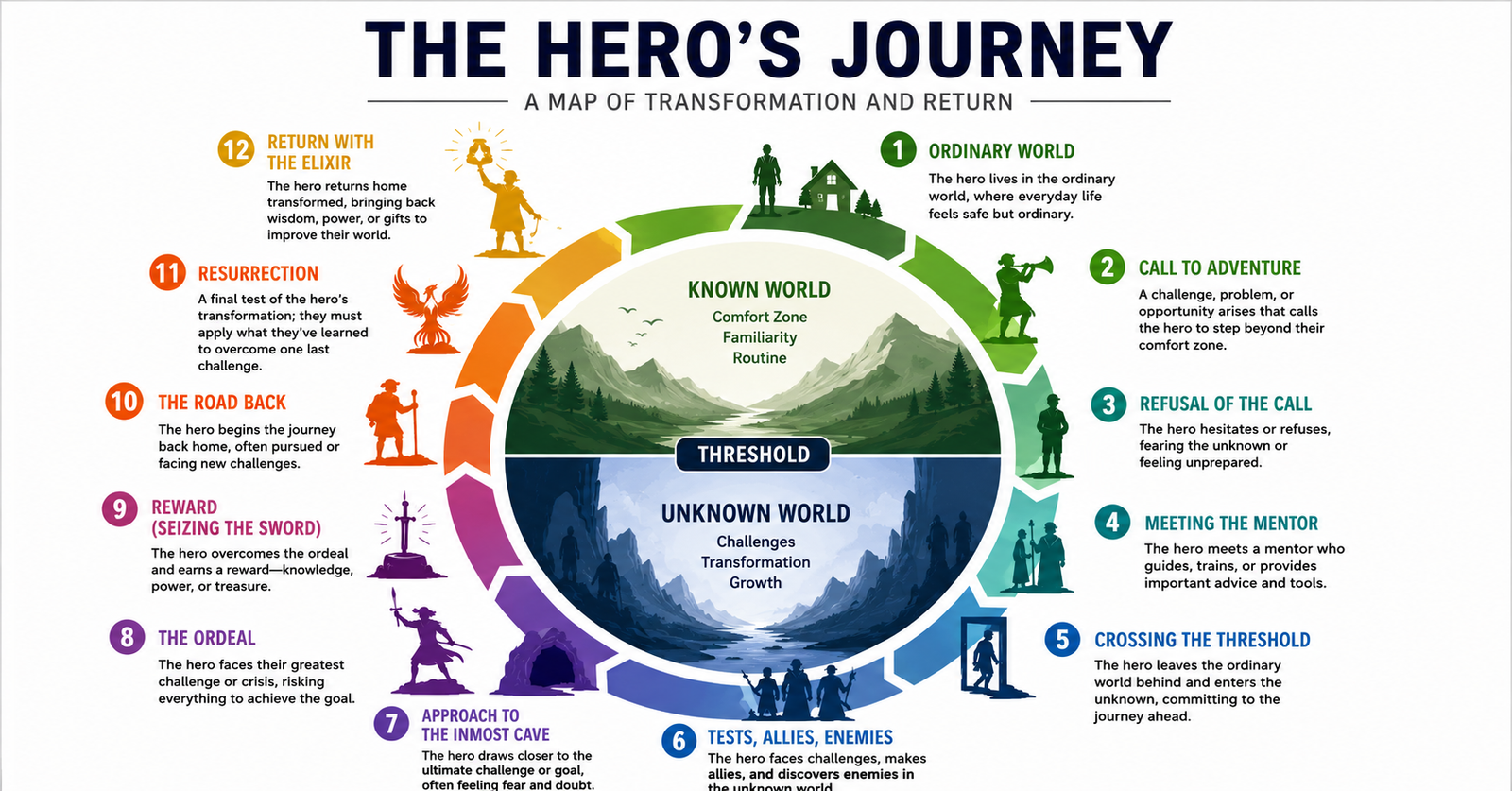
A hero’s journey chart is a visual map of the storytelling pattern first identified by mythologist Joseph Campbell in his 1949 book The Hero with a Thousand Faces. Campbell studied myths from cultures around the world and noticed that heroes — whether Greek, Norse, Indian, or Indigenous American — tend to move through similar phases: they leave their ordinary world, face trials, hit a low point, and return home changed.
The chart takes that idea and turns it into something writers can actually use: a circular or linear diagram showing each stage in order, often with the hero’s emotional arc plotted alongside it.
Also Read: Story Structure Explained The Secret Formula Behind Every Story You Love
Screenwriter Christopher Vogler later adapted Campbell’s original 17 stages into a simpler 12-stage version for his book The Writer’s Journey, and that’s the version most modern charts are based on.
The 12 Stages of the Hero’s Journey (With a Simple Chart)
Here’s a quick-reference table you can use while outlining your own story.
| Stage | What Happens | Story Example |
|---|---|---|
| 1. Ordinary World | The hero’s normal life before the adventure begins | Frodo living quietly in the Shire |
| 2. Call to Adventure | Something disrupts normal life and invites change | Frodo learns the ring is dangerous |
| 3. Refusal of the Call | The hero hesitates or resists | Frodo doesn’t want to leave the Shire |
| 4. Meeting the Mentor | A guide offers wisdom, tools, or training | Gandalf advises Frodo |
| 5. Crossing the Threshold | The hero commits and enters the unknown world | Frodo leaves the Shire |
| 6. Tests, Allies, Enemies | The hero learns the rules of the new world | Fellowship forms; enemies emerge |
| 7. Approach to the Inmost Cave | Preparation before the biggest challenge | Approaching Mordor |
| 8. Ordeal | The hero faces their greatest fear or crisis | Frodo confronts Shelob |
| 9. Reward (Seizing the Sword) | The hero gains something from surviving the ordeal | Frodo and Sam press on |
| 10. The Road Back | The hero commits to finishing the journey | Marching toward Mount Doom |
| 11. Resurrection | A final, transformative test | Frodo’s struggle at the fire |
| 12. Return with the Elixir | The hero returns home, changed, with something to share | The Shire is saved and healed |
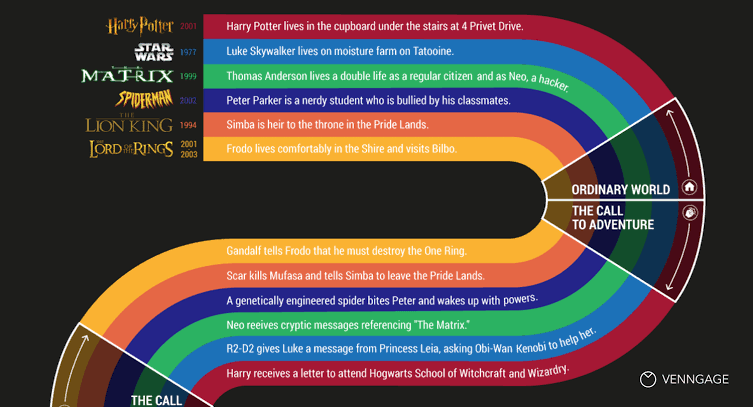
You’ll notice this pattern isn’t limited to fantasy epics. It shows up in Star Wars, The Lion King, Harry Potter, and countless personal essays, business origin stories, and even video game narratives.
Why the Circular Version Is So Popular
Most hero’s journey charts are drawn as a circle rather than a straight line, and there’s a good reason for that. The hero doesn’t just move forward through events — they leave a known world, go through change in an unknown one, and return to where they started, but transformed. The circular shape shows that “return” visually in a way a straight timeline can’t.
Hero’s Journey vs. Other Story Structures
People often confuse the hero’s journey with other popular frameworks. Here’s how they differ:
| Framework | Structure Type | Best For |
|---|---|---|
| Hero’s Journey (Campbell/Vogler) | 12–17 stage circular arc | Myths, epics, character-driven fiction |
| Three-Act Structure | Setup, confrontation, resolution | Screenplays, general fiction |
| Save the Cat Beat Sheet | 15 specific plot beats | Commercial screenwriting |
| Freytag’s Pyramid | Rising action, climax, falling action | Classic drama and tragedy |
The hero’s journey isn’t better or worse than these — it’s simply focused on internal transformation as much as external plot, which is why it works so well for character-driven stories.
How to Use a Hero’s Journey Chart in Your Own Writing
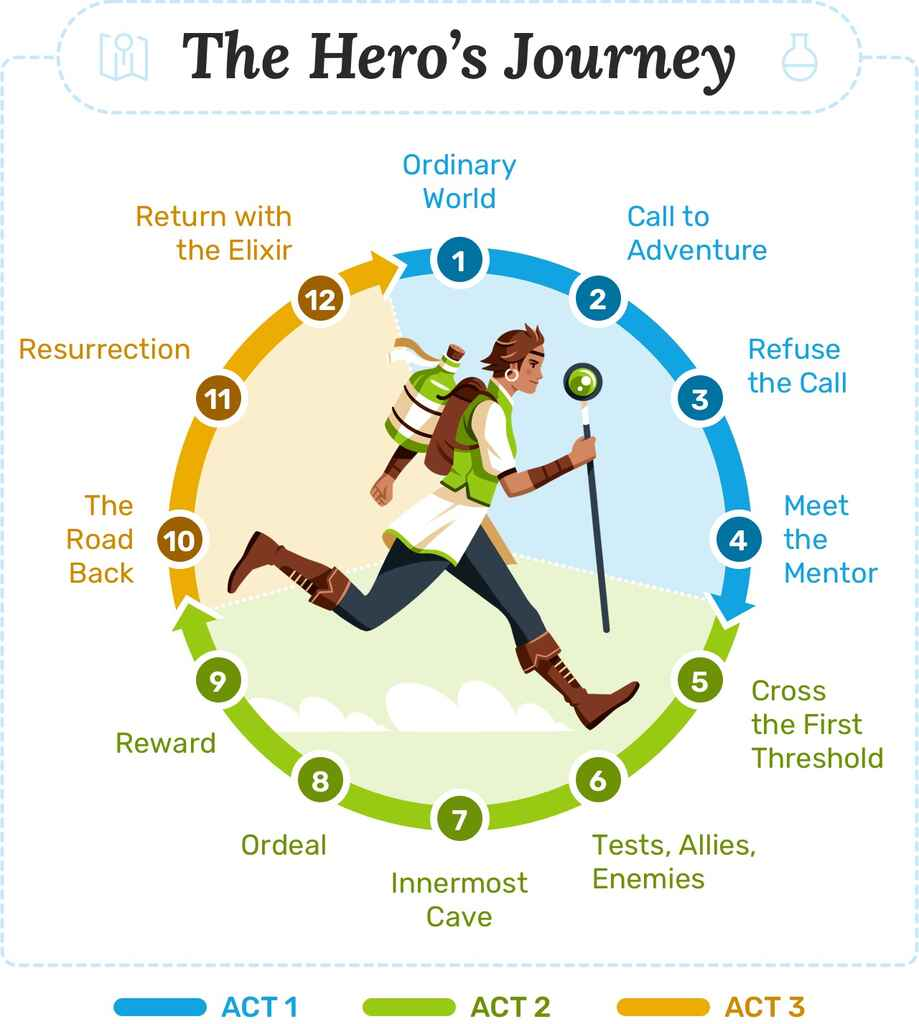
You don’t need to hit every single stage in strict order. Many published novels skip stages, combine them, or rearrange them. Think of the chart as a checklist of possibilities, not a mandatory sequence.
A practical way to use it:
- Start by identifying your hero’s “ordinary world” — what does normal life look like before the story begins?
- Decide what event forces them out of that world.
- Map out one or two allies and one clear antagonist or obstacle.
- Identify the single hardest moment your hero will face (the ordeal).
- Decide what your hero gains or loses by the end, and how they’re different from who they were at the start.
If you fill in just these five points, you already have the skeleton of a working story, even before touching the full 12-stage chart.
Common Mistakes Writers Make With This Chart
- Forcing every stage in order. Real stories bend the structure; readers don’t notice missing stages, but they do notice forced ones.
- Treating it as a plot formula instead of a character arc. The real value is tracking emotional change, not just events.
- Ignoring the “ordinary world.” Skipping this stage makes it hard for readers to feel the contrast once the adventure begins.
- Overcomplicating the ordeal. It should be the hero’s biggest personal test, not just the biggest explosion.
Who Uses the Hero’s Journey Chart Today?
This chart isn’t just for novelists. It shows up in:
- Screenwriting — many Hollywood story consultants still reference Vogler’s version during development.
- Content marketing — brands use a simplified version to structure customer success stories (“before,” “struggle,” “transformation”).
- Game design — many RPGs and story-driven games map their main quest lines loosely onto this arc.
- Personal storytelling and speeches — TEDx-style talks often follow a mini hero’s journey: normal life, challenge, struggle, lesson learned.
That range is part of why the framework has stayed relevant for more than 70 years — it reflects something close to how humans naturally process change and growth, not just how movies are built.
A Balanced Look: Limitations of the Hero’s Journey
It’s worth being honest here — this structure isn’t universal, and some critics argue it overrepresents a Western, male-centered narrative pattern. Scholars like Maureen Murdock later proposed a “Heroine’s Journey” to address gaps in how female protagonists’ arcs are often shaped differently. Other stories, especially ensemble casts or slice-of-life narratives, don’t map onto a single hero arc at all.
Use the chart as one useful lens among several, not the only correct way to build a story.
Conclusion
A hero’s journey chart is one of the most practical tools a writer can use to visualize character transformation, whether you’re outlining a novel, a screenplay, or even a personal essay. It works because it mirrors something real: people change through struggle, and stories that reflect that tend to resonate. Use the 12-stage table above as a starting point, adapt it freely, and don’t be afraid to skip or reorder stages to fit the story you actually want to tell.
Also Read: The 3 Act Story Structure A Simple Guide That Actually Works
FAQs
What is a hero’s journey chart used for?
It’s used to visually map the stages a protagonist typically moves through in a story, helping writers plan structure, pacing, and character transformation before or during drafting.
Who created the hero’s journey structure?
Joseph Campbell introduced the concept in 1949, based on comparative mythology. Christopher Vogler later simplified it into the 12-stage version most commonly used today.
Is the hero’s journey the same as the three-act structure?
The three-act structure focuses on plot pacing (setup, confrontation, resolution), while the hero’s journey focuses more on the character’s internal transformation across a circular arc.
Do all good stories follow the hero’s journey?
Many successful stories, especially ensemble or literary fiction, don’t follow this structure at all. It’s a helpful tool, not a rule.
Can I use a hero’s journey chart for non-fiction or marketing?
Many marketers and speakers use a simplified version to structure case studies, brand stories, and presentations around a relatable transformation arc.
Where can I find a free hero’s journey chart template?
Many writing tools, story-planning apps, and educational sites offer free downloadable versions — usually as a circular diagram with the 12 stages labeled around it.
For more updates visit: STORY VISTA