You’ve probably felt it before finishing a book or a movie that sense that something is building toward a moment, then everything shifts, then it all comes together at the end. That feeling isn’t an accident. It’s usually the 3 act story structure doing its job quietly in the background.
If you’ve ever tried to write a story and hit a wall around the middle not sure what happens next, not sure how to get to the ending the problem often isn’t your idea. It’s that you don’t yet have a shape to pour it into. The three-act structure is that shape. It’s been used since Aristotle first wrote about how stories work, and it’s still the backbone of most novels, screenplays, and short stories being published today.
This guide walks through what the 3 act story structure actually is, how each act works, real examples you’ll recognize, and how to use it without making your story feel formulaic.
What Is the 3 Act Story Structure?
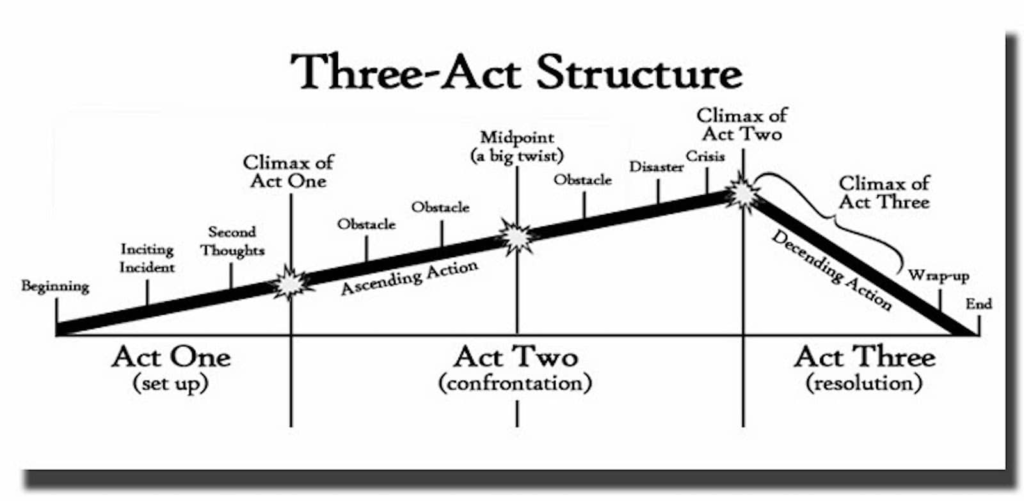
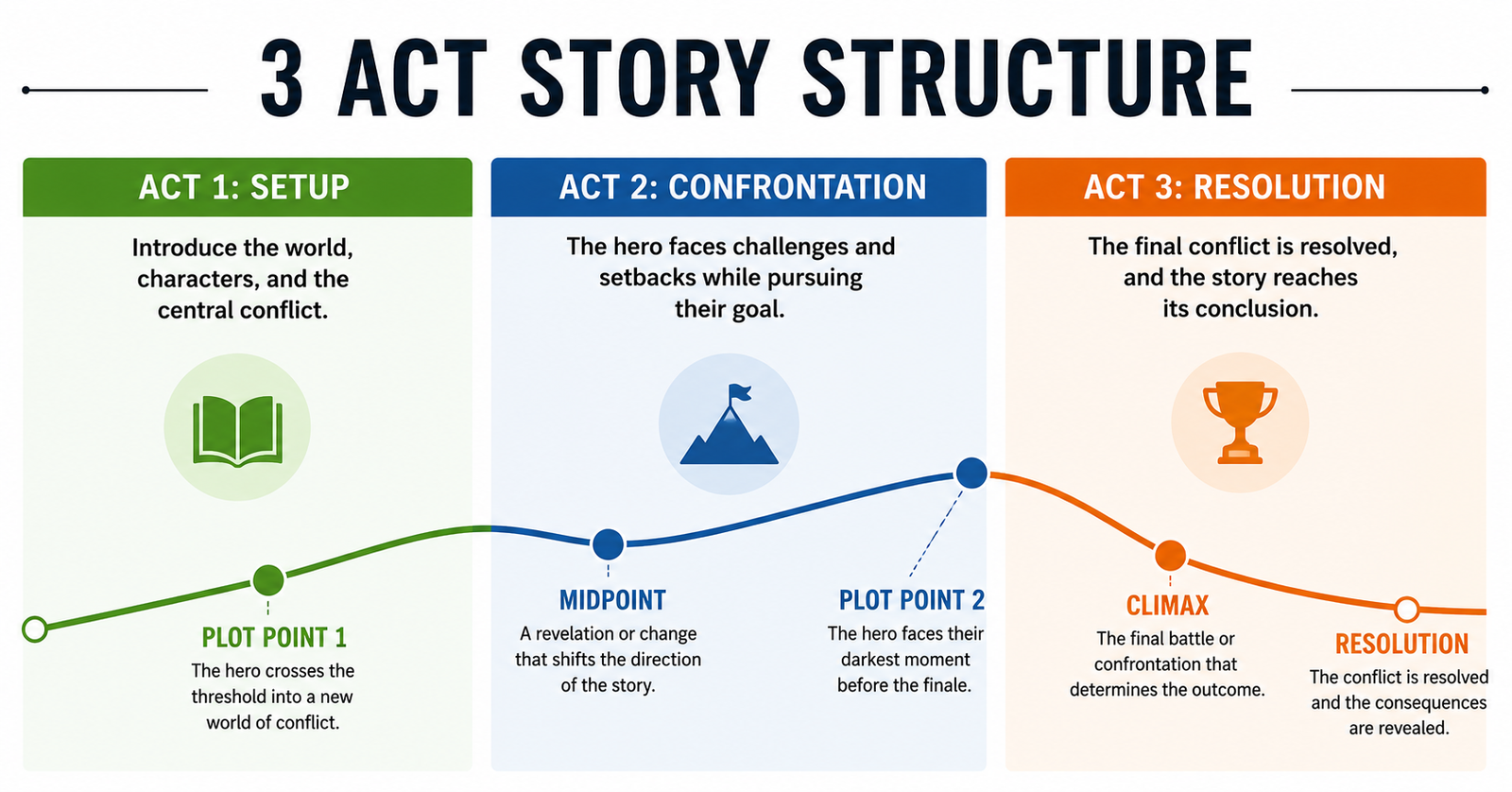
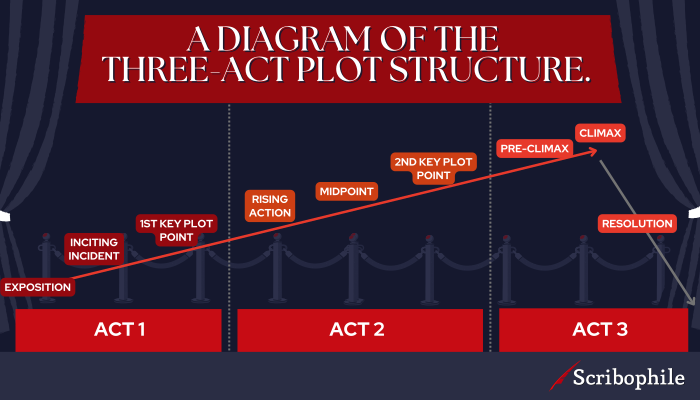
The 3 act story structure is a way of organizing a narrative into three parts: a beginning, a middle, and an end. In storytelling terms, these are usually called Setup, Confrontation, and Resolution.
- Act 1 (Setup) introduces the world, the main character, and the problem they’re about to face.
- Act 2 (Confrontation) is where that problem gets harder to avoid, and the character has to fight through rising obstacles to deal with it.
- Act 3 (Resolution) is where everything comes to a head, the conflict is resolved, and the story settles into its new normal.
It sounds simple because it is simple that’s the point. The structure gives a story momentum. Readers and viewers instinctively expect a beginning that hooks them, a middle that tests the character, and an end that pays it off. When a story skips one of these, it tends to feel unfinished or confusing, even if the reader can’t say exactly why.
Also Read: Story Structure Explained The Secret Formula Behind Every Story You Love
Why the 3 Act Structure Still Works in 2026
Writers have tried plenty of alternatives over the years the five-act structure, Freytag’s Pyramid, the Hero’s Journey, Save the Cat’s beat sheet. Each has its place. But the three-act structure has stuck around for a simple reason: it matches how people naturally process change.
Every satisfying story is really about a character who wants something, runs into resistance, and comes out the other side changed. The three-act structure is just a container built around exactly that arc. It doesn’t tell you what to write — it tells you how to pace what you’ve already got so it lands.
Breaking Down Each Act
Act 1: Setup (Roughly the First 25%)
Act 1 has one job: make the reader care enough to keep going. In this act, you typically cover:
- Introducing the protagonist — who they are, what their normal life looks like, what they want (even if they don’t fully know it yet).
- Establishing the setting — where and when the story takes place.
- The inciting incident — the event that disrupts the character’s normal life and starts the story moving.
- Plot Point One — the moment the character commits to dealing with the problem, officially ending Act 1.
A useful way to think about it: Act 1 answers the question “why should I keep reading?” If a reader closes the book after chapter one, it’s almost always because Act 1 didn’t do this job.
Act 2: Confrontation (Roughly the Middle 50%)
This is the longest act, and the one most writers struggle with — the dreaded “saggy middle.” Act 2 is where the character actively pursues their goal and keeps running into obstacles that get harder as the story goes on.
Good Act 2s usually include:
- Rising action — a series of escalating challenges or complications.
- A midpoint twist — a turning point roughly halfway through the story that raises the stakes or changes the character’s understanding of the problem.
- Setbacks — things get worse before they get better, often building to a low point near the end of the act.
The trap most new writers fall into is treating Act 2 as filler between the exciting parts. It isn’t. It’s where the character actually changes, and where the reader becomes emotionally invested enough to care about the ending.
Act 3: Resolution (Roughly the Final 25%)
Act 3 delivers on everything the first two acts promised. It includes:
- The climax — the final, highest-stakes confrontation with the core conflict.
- The resolution — the immediate aftermath of the climax.
- The denouement — loose ends tied up, showing the character’s new normal.
A strong Act 3 doesn’t introduce brand-new problems out of nowhere. It pays off what Acts 1 and 2 already set up. That’s what makes an ending feel earned instead of rushed.
3 Act Structure Examples You’ll Recognize
Seeing the structure in something familiar makes it click faster than any definition can.
The Wizard of Oz
- Act 1: Dorothy feels out of place in Kansas; a tornado sweeps her into Oz.
- Act 2: She teams up with the Scarecrow, Tin Man, and Cowardly Lion, facing obstacles on the way to the Wizard and eventually the Wicked Witch.
- Act 3: She defeats the Witch, learns she had the power to go home all along, and returns to Kansas changed.
Jurassic Park
- Act 1: Scientists and visitors arrive at a dinosaur theme park full of promise and quiet warning signs.
- Act 2: The park’s systems fail, dinosaurs escape, and the characters fight to survive.
- Act 3: The survivors escape the island, having learned the cost of underestimating nature.
The Dark Knight
- Act 1: Batman is winning his fight against organized crime in Gotham.
- Act 2: The Joker escalates chaos, pushing Batman and Gotham to their limits.
- Act 3: Batman makes a personal sacrifice to preserve hope in the city, even at cost to his own reputation.
3 Act Structure vs. Other Story Structures
| Structure | Best For | Number of Parts |
|---|---|---|
| Three-Act Structure | Most novels, screenplays, short stories | 3 |
| Hero’s Journey | Mythic, character-driven, transformation stories | 12 stages |
| Save the Cat Beat Sheet | Genre fiction, screenwriting, tightly plotted stories | 15 beats |
| Freytag’s Pyramid | Classic drama and tragedy | 5 parts |
None of these structures is “better” across the board. The three-act structure tends to be the easiest starting point because it’s flexible enough to fit almost any genre, while frameworks like the Hero’s Journey or Save the Cat give you more detailed beats once you’re ready for finer control.
Common Mistakes Writers Make With the 3 Act Structure
- Rushing Act 1. If readers don’t understand what the character wants, they won’t care what happens next.
- Letting Act 2 wander. Every obstacle in the middle should raise the stakes or reveal something new — not just delay the ending.
- Resolving the conflict too easily. A climax that isn’t earned by the struggles in Act 2 will feel unsatisfying, even if it’s technically “exciting.”
- Treating percentages as strict rules. The 25/50/25 split is a helpful guideline, not a law. Plenty of great stories bend it.
How to Use the 3 Act Structure in Your Own Writing
- Start with your ending. Knowing where the story lands makes it much easier to build toward it.
- Identify your inciting incident — the moment that kicks the whole story into motion.
- List the obstacles your character will face in Act 2, and make sure each one is harder than the last.
- Find your midpoint — the moment that changes what your character (and reader) understands about the story.
- Write your climax before you write the rest of Act 3, so every earlier scene can build toward it.
Final Thoughts
The 3 act story structure isn’t a formula that makes every story sound the same — it’s a scaffold that lets you focus your energy on character and conflict instead of getting lost in structure. Once you internalize the rhythm of setup, confrontation, and resolution, you’ll start noticing it everywhere: in the books you love, the shows you binge, even in how a good conversation naturally builds and lands. Use it as a starting point, not a cage, and it’ll make your stories stronger without making them predictable.
Also Read: 10 Storytelling Techniques That Actually Hook Readers
FAQs
What is the 3 act story structure in simple terms?
It’s a way of organizing a story into a beginning (setup), middle (confrontation), and end (resolution), so the plot builds naturally and pays off by the final act.
Who created the three-act structure?
It’s often traced back to Aristotle’s writings on drama, though the modern three-act format used in film and fiction was popularized much later by screenwriting teachers and story analysts.
How long should each act be?
A common guideline is Act 1 at about 25%, Act 2 at about 50%, and Act 3 at about 25% of the total story — but this varies by genre and format, and isn’t a strict rule.
Is the 3 act structure only for movies?
It works for novels, short stories, video games, and even personal essays. Anywhere there’s a character facing a problem that builds and resolves, the structure applies.
What’s the difference between the three-act structure and the Hero’s Journey?
The three-act structure is a simple three-part framework. The Hero’s Journey is a more detailed, 12-stage version built specifically around a character’s transformation, often used for mythic or epic stories.
Can a story break the three-act structure?
Many literary and experimental works intentionally subvert or ignore it. But most commercially successful, reader-friendly stories still follow its basic rhythm, even loosely.
For more updates visit: STORY VISTA